
MONTHLY NEWSLETTER – JUNE 2026
July 1, 2026 |
Download Document
A summary of key events and market trends during the month of June
Global Markets Updates
- The Fed held rates at 3.50%-3.75% on June 17 in a unanimous 12-0 vote, but the Federal Reserve’s dot plot turned hawkish — the 2026 median rose to 3.8%, implying a hike rather than the cut previously projected. This was Kevin Warsh’s first meeting as Fed chair, and 17 of 18 officials now see inflation risks tilted to the upside. It’s a genuine regime change in forward guidance after three years of an easing bias.
- The Bank Of Japan raised its policy rate 25bps to 1.0% on June 16 — the highest level since 1995 — in a 7-1 vote, driven by wholesale inflation hitting 6.3% in May, the highest since March 2023, as the US-Iran war keeps oil elevated.
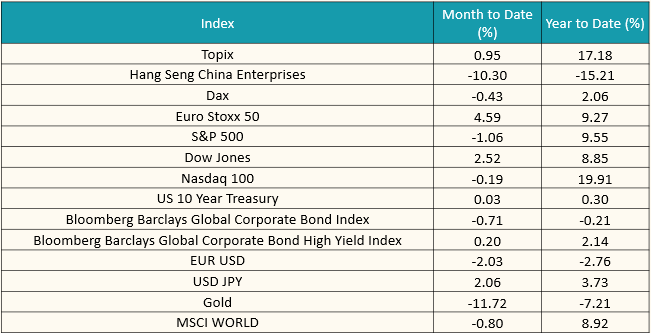
- Normally a hike would firm the Japanese Yen, but it hasn’t stuck: despite an estimated ¥11.7 trillion ($73.5 billion) in intervention spending during May and the largest quarterly FX intervention since 2004, the yen touched ¥161.95/USD on June 29 — its weakest since December 1986 — and closed the month at ¥162.60, down over 13% year-on-year.
- The driver is the widening Fed-BOJ gap and FX traders of $ vs JPY are paying attention: with Warsh’s Fed leaning hawkish but still near 3.6-3.75% and the BOJ only just reaching 1%, the rate differential keeps favoring dollar carry trades over intervention and a very gradual push toward a neutral rate via hikes every few months.
- The Iran war and the effective closure of the Strait of Hormuz have been the dominant macro variable. Brent fell nearly 20% in May on ceasefire optimism even though the Strait remained effectively closed the whole month, and as of late June markets are still watching whether the fragile US-Iran arrangement holds. This is the single biggest driver of the inflation surprise feeding into Fed policy. Gasoline prices in the US are a key domestic politics variable ahead of the summer driving season and is likely part of the overall mid-term election calculus used by both sides of the political aisle.
- The five largest hyperscalers are on track to spend $700-900 billion on capex in 2026, a 36% increase over 2025, with Amazon alone guiding to $200 billion and Alphabet roughly doubling guidance to $175-185 billion. But the AI capex-to-revenue growth divergence is running around 46%, already exceeding the 32% divergence seen in the 2001 telecom bust, and Broadcom’s weak guidance triggered a sharp early-June selloff as investors questioned whether AI valuations can hold without imminent rate cuts — with Dimon and Dalio both flagging bubble risk.
- The Volatility Index (VIX) flirted with levels slightly north of 20, a key pivot level, earlier in June on conflicting news from the Middle East but has now settled well below that level. Risk appetite as a result continues to be robust in the short term.
Heading into the mid year key themes remain unchanged
The AI rally, global geopolitics in the Middle East and Eastern Europe and a new Federal Reserve Governor continue to dominate the cyclical news-flow
Over the next few months, the market will shift attention to the upcoming mid-term elections in the US
Key Markets
SGMC Forward Views
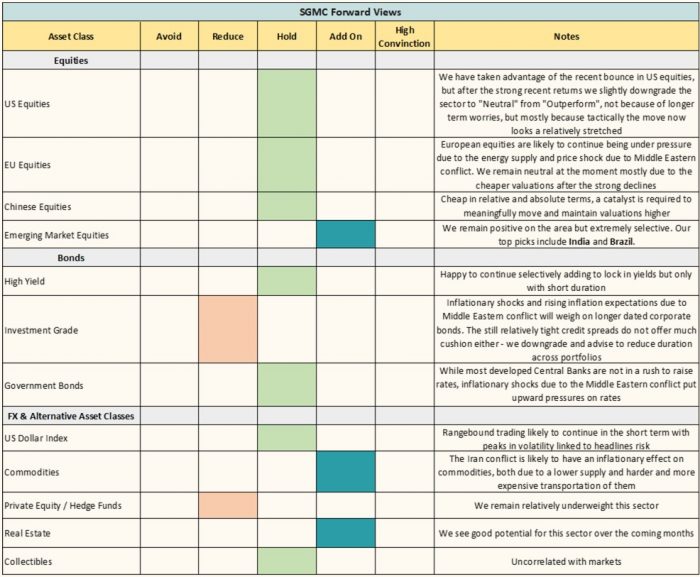
- No changes to our forward views this month