
MONTHLY NEWSLETTER – JULY 2026
August 1, 2026 |
Download Document
A summary of key events and market trends during the month of July
Global Markets Updates
- The latest earnings round showed continued strength across the major cloud and digital-platform businesses. Microsoft Azure, AWS and Google Cloud led the pack with Meta’s 28% revenue growth coming in at a still strong 28%. The broader conclusion is that demand for cloud and AI services remains strong and is becoming increasingly visible in reported revenue.
- Capital expenditure figures at these hyperscalers are rapidly accelerating as they race each other to build larger data centers. The total annual spend figure is rapidly approaching the trillion dollar landmark and management teams continue to report that customer demand exceeds available capacity, although higher equipment and memory prices are also contributing to the increase in spending.
- Recent open-weight language as multi-modal models are narrowing parts of the capability gap with proprietary systems while becoming cheaper and more practical to deploy. Progress is coming from a combination of sparse architectures, lower-precision computation, improved attention mechanisms and better inference software. This gives users greater flexibility to select, customize or operate models for specific workloads and should place some pressure on model pricing. Open-weight models are not yet uniformly equal to the strongest proprietary models, however, and we expect to see a wide variety of models proliferating, each used for the micro-task they are best suited.
- The recent forced unwinding at Leopold Aschenbrenner’s Situational Awareness fund, alongside the wave of deleveraging among South Korean retail investors, is a reminder that positioning matters as much as conviction. In both cases, concentrated bets on volatile semiconductor names—amplified by margin and leveraged single-stock products—meant that what began as a routine drawdown quickly turned into forced selling. None of this undermines the longer-term investment case for AI infrastructure or memory, but it does highlight a familiar market truth: even the right macro thesis can produce painful outcomes when leverage, liquidity and position sizing are misaligned with the volatility of the underlying assets.
- As AI continues to power ahead in terms of providing new technological capabilities we expect to see some investor segments getting carried away by inducing similar such volatility into the markets. We wait patiently for these events to take advantage in the temporary drop in asset prices for our long-term oriented portfolios.
- The Volatility Index (VIX) again continues in a tight trading range between the year’s lows of around 16 and the highs of around 20. Despite large sell-offs in some leading AI stocks in July there was not much demand to hedge overall portfolio risk and the relatively stable environment augurs well for risk appetite.
Resumption of hostilities in the Middle East leads to oil spiking again
With the ceasefire breaking down oil rallied around 30% and brings back inflationary pressures as a concern for Central Bankers
The Fed Reserve held rates for the fifth meeting in a row and Chair Warsh’s style of communicating is taking some getting used to
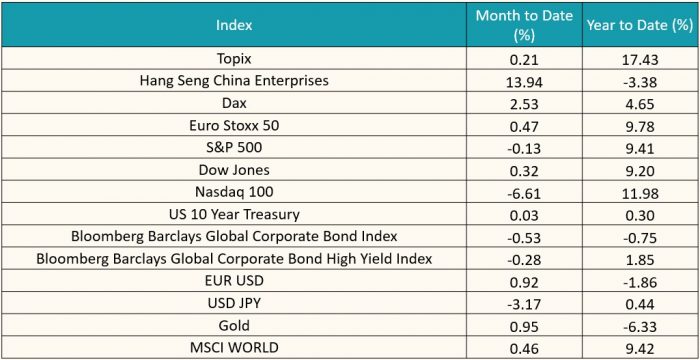
Key Markets
SGMC Forward Views
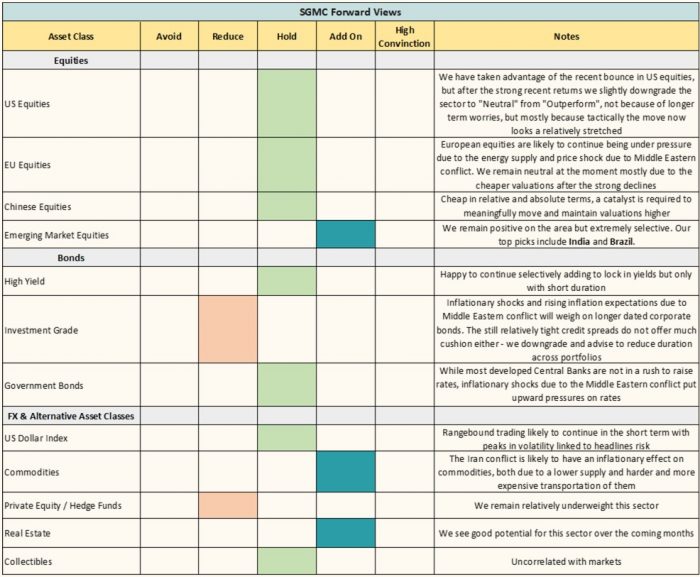
- No changes to our forward views this month